My view is there are no aliens whatsoever due to the way and length of time and circumstances it took to create human and other life.
But...there could always be other miracles happening throughout our vast universe and multi-verses.
I will look at supposed theories plus the views by noted cosmologists and of course astronauts....but first we will start at the centre of alien speculation and discoveries...Peru.
Ancient Aliens
The intersection of "ancient aliens" and "artificial intelligence" combines speculative fringe theories with modern technology. It explores whether myths of ancient gods refer to past encounters with advanced extraterrestrial AIs, and how modern AI tools are currently being used to uncover undiscovered artifacts, symbols, and structures.
1. The "Ancient AI" Theory
A prominent speculative theory in ufology and sci-fi suggests that highly advanced extraterrestrial civilizations would likely outlive their biological creators.
The Theory: Any alien species capable of crossing interstellar distances would likely merge with—or be entirely succeeded by—AI. Therefore, the "gods" descending from the sky in ancient texts, or the builders of cosmic watchdogs and monoliths, were likely immortal, self-replicating, or centuries-old machines rather than biological beings.
Historical Ties: Proponents of this theory point to myths like the Hindu Vimanas or the Greek myth of Talos (an automaton said to protect the island of Crete) as potential historical sightings of ancient alien AI.
2. Modern AI Archaeological Discoveries
Outside of theory, modern AI is actively reshaping paleocontact and archaeological research. Researchers and archaeologists are applying machine learning to satellite imagery and aerial photography to find hidden structures.
Nazca Lines in Peru: Artificial intelligence and deep-learning algorithms have been used to scan the Peruvian desert. By analysing faint, eroded geoglyphs that are no longer visible to the naked eye from the air, AI has successfully identified dozens of new, previously unknown geoglyphs.
Space Archaeology: Programs like GlobalXplorer use algorithms to spot surface anomalies that could indicate lost ancient cities, tombs, or monuments.
3. AI for ET Communication
As our own AI capabilities grow, scientists are actively discussing how to use machine learning and large language models to construct messages for (or interpret messages from) potential extraterrestrial civilizations. Because alien communication could be radically different from human languages, AI is being tasked with looking for "universal mathematical and structural patterns" in cosmic signals.
For a fascinating look at how modern machine learning is uncovering hidden, mysterious figures etched into the landscape of Peru:
Peru is a focal point for the "ancient astronaut theory," which suggests extraterrestrial beings visited and shaped early human civilizations. Theorists point to the region's colossal megalithic architecture, massive geoglyphs, and enigmatic artifacts as evidence of advanced, non-human technology.
Key Theories and Sites
- The Nazca Lines: Enormous geoglyphs etched into the desert, depicting animals, geometric shapes, and a figure resembling an astronaut. Theorists suggest they were used as runways or navigational beacons for advanced spacecraft.
- Megalithic Architecture: Sites like the fortress of Sacsayhuamán near Cusco feature stones weighing up to 360 tons, fitted together with exact precision. Proponents argue that the stone-cutting and transport methods surpass the capabilities of the ancient Inca.
- Paracas Elongated Skulls: Discovered on the southern coast of Peru, these elongated skulls have unusual cranial volumes. While anthropologists attribute them to artificial cranial deformation, some theorists speculate they belong to a distinct or extraterrestrial lineage.
Conventional Explanations
Mainstream archaeologists attribute these wonders to human ingenuity. The Nazca Lines are widely considered ritual pathways related to water and astronomy. The impressive stonework seen at sites like Sacsayhuamán is credited to advanced engineering techniques developed by the Inca and pre-Inca cultures, involving thousands of laborers.
Megalithic Structures of Peru
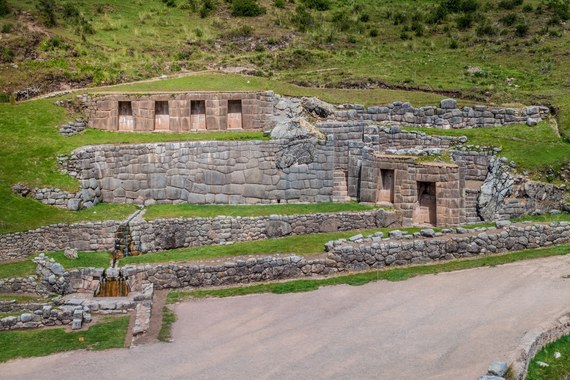
Peru is home to some of the most impressive and mysterious megalithic architecture in the world. Characterized by massive stones intricately cut, polished, and fitted together without mortar—often with such precision that a knife blade cannot fit between the joints—these structures span from ancient pre-Inca hunter-gatherer sites to the towering citadels of the Inca Empire.
Key Megalithic Sites
- Sacsayhuamán (Cusco): Overlooking the ancient capital of the Inca Empire, this fortress is famous for its massive zigzag terrace walls. Some of the colossal andesite and limestone blocks here weigh over 100 tons.
- Ollantaytambo (Sacred Valley): A masterclass in ancient engineering, this site features the unfinished Temple of the Sun. It showcases enormous pink rhyolite megaliths that were quarried from a mountain across the river and fitted together with incredibly precise, polygonal masonry.
- Callacpuma (Northern Highlands): Recent archaeological discoveries have dated a large, circular megalithic plaza here to around 4,750 years ago. This makes it one of the oldest monumental ceremonial structures in the Americas.
- Machu Picchu: While best known for its overall layout, this mountaintop city showcases extraordinary, master-level megalithic masonry, particularly in its distinct agricultural terraces and the intricately carved Intihuatana stone.
- Aramu Muru (Puno): Located near Lake Titicaca, this site features a mysterious, deep "doorway" carved directly into a massive rock face, frequently discussed in local legends.
Construction Techniques & Theories
Cusco
Cusco, the historic capital of the Inca Empire, is a major hub for extraterrestrial theories, ancient astronaut speculations, and UFO tourism. Theorists suggest that the region's megalithic architecture, elongated skulls, and underground tunnel networks hint at otherworldly contact.
The massive, interlocking stone walls found in and around Cusco—most notably at the Sacsayhuamán fortress—are a focal point for alien theorists.
The Puzzle: The stones are cut so perfectly without mortar that a piece of paper cannot fit between them, and some weigh over 100 tons.
The Theory: Proponents of the ancient astronaut theory argue that primitive humans could not have cut, transported, and fit these stones together so precisely. Some theorists even suggest the builders used unknown technology to "soften" the stones like clay before shaping them.
The exact methods used to quarry, transport, and perfectly shape these dense stones (like granite, andesite, and basalt) remain a subject of debate. While mainstream archeology attributes the stonework to advanced pre-Inca cultures (such as the Kilke) and the later Inca Empire, traditional Inca folklore sometimes credits a prior, ancient race of giants or divine beings with the creation of the oldest, heaviest stone blocks.
The spectacular megaliths of Cusco, including the massive interlocking walls of Sacsayhuamán and the foundations of Qurikancha, were built primarily by the Inca civilization in the 15th century under the reign of Emperor Pachacuti and his successors.
Cusco's megalithic architecture is particularly famous for its masterfully carved and fitted boulders (some weighing over 100 tons) that interlock perfectly without the use of mortar.
While the definitive stonework we see was perfected and raised by the Inca, there are several cultural and historical layers to consider:
- The Inca: Starting around 1438 AD, the Inca extensively reshaped Cusco into a sacred, puma-shaped city, building the monumental dry-stone structures we marvel at today. Their stonemasons used bronze tools, sand abrasives, and immense human labour to extract limestone, diorite, and andesite from local quarries.
- Pre-Inca Builders: The Inca built their capital on top of pre-existing settlements. Historians note that the early Killke culture inhabited the Cusco valley prior to the Inca and may have constructed foundational terraces that the Inca later expanded.
- Spanish Adaptation: Following the 16th-century conquest, the Spanish dismantled many Inca structures, but repurposed these massive megalithic foundations and stones as the bases for their own colonial churches and mansions in the Historic Centre of Cusco.
- Because of the sheer scale of the rocks, Spanish chroniclers initially struggled to believe the Inca built them without iron tools, which led to centuries of myths about giants or supernatural beings. Today, historians and archaeologists agree it was the product of immense, organized Incan engineering and unparalleled masonry skills.
The Cusco region and the broader Andean area are famous for elongated human skulls discovered in ancient burial sites.
The Theory: Some researchers claim these unnatural, elongated craniums are physical proof of extraterrestrial beings or alien-human hybrids. Anthropologists, however, attribute these shapes to intentional cranial deformation, a cultural practice of binding the skull during infancy to signify social status.
Underground Tunnels & The Sun Disk
Legends in Cusco tell of an ancient, miles-long subterranean labyrinth hidden beneath the city streets.
The Theory: Theorists speculate that these underground networks connect to a wider, mysterious cave system. According to local lore, the Incas used these tunnels to hide their sacred, golden Sun Disk from the invading Spanish conquistadors.
For a more modern and tangible connection, you can visit Area 21, an eco-museum and sculpture park located in the rural community of Sencca (just outside Cusco). Created by local artist Tupaq Kamariy Candia, the park features giant alien sculptures, flying saucers, and sci-fi art that plays directly into the area's supernatural reputation.
Exploring the extraterrestrial side of Cusco involves a mix of physical theme parks and historical sites tied to "ancient astronaut" lore:
Located near Cusco, this outdoor art and sculpture park features large-scale models of UFOs, flying saucers, and extraterrestrial beings.
Sacsayhuaman: This massive ancient complex just outside the city is famous for its 220-ton interlocking stones. Proponents of the Ancient Aliens theory frequently point to the site's impossibly precise mortarless cuts as evidence of advanced or extraterrestrial assistance.
Andean Rites Museum (Museo Ritos Andinos): Located in the nearby town of Andahuaylillas, this museum features controversial displays of "alien skeletons" and elongated skulls that local lore attributes to sky gods, though anthropologists attribute the shape to intentional cranial deformation.
Zona X & Quillarumiyoc: Sites near Cusco with strange rock carvings, carved stairwells leading upside-down, and amphitheaters that attract UFO researchers.
PB