

Sydney, Afghanistan
In the Beginning
Earth has existed for 4.54 billion years, and during that time, our planet has undergone a number of violent transitions.
Long ago, 335 to 100 million years ago, all Earth's land was joined in one giant supercontinent named Pangea. Australia sat near the south pole of this huge mass. Pangea was formed during the Carboniferous period when the landmasses collided. It remained a supercontinent during he Permian and Triassic periods.
Pangea started breaking apart 175 to 180 million years ago , at the start of the Juassic period, leaving a southern landmass called Gondwanaland, which incorporated the now countries of Australia, Antarctica, India, South America and Africa, as well as the continents we know today.
Australia started pulling away from Antarctica around 180 million years ago. The last land bridge between Tasmania and Antarctica finally broke around 45 to 35 million years ago.
During the last ice age land bridges connected Australia to Tasmania and New Guinea into a continuous landmass called Sahul. Rising flood water and continental shift flooded and separated these land bridges around 10,000 years ago, creating Bass Strait and Torres Strait.
The Oldest Country Geologically
Australia has a strong claim to being the oldest country geologically, holding the oldest known fragments of Earth's crust on the planet.
- Jack Hills Zircons: Scientists found tiny zircon crystals in the Jack Hills of Western Australia that date back 4.4 billion years.
- Ancient Crust: These crystals are the oldest recorded terrestrial material ever discovered, showing that Earth's crust cooled down very soon after the planet formed.
- The Pilbara Region: The Pilbara region in Western Australia contains some of the oldest exposed rock formations and ancient fossilized stromatolites dating back more than 3.5 billion years.
Other Ancient Geological Regions
Canada:
Home to the Canadian Shield, which features the Acasta Gneiss - some of the oldest intact bedrock and crustal rocks on Earth, date at roughly 4 billions years old.
Greenland:
Contains ancient 3.8 billion year old rock sequences and tectonic evidence.
Why is Australia called "old"?
Australia is not the oldest land on Earth as a complete continent, but it contains some of the oldest fragments of Earth material and crust found anywhere on the planet.
- It contains the oldest materials: Western Australia's Jack Hills hold tiny zircon crystals that date back about 4.4 billion years, making them the oldest known material of terrestrial origin on Earth.
- There are ancient cores: Large areas of Western Australia, such as the Yilgarn and Pilbara cratons, formed over 3 billion years ago as stable pieces of early continental crust.
- (Cratons are an old and stable part of the Earth's continental lithosphere that has survived cycles of merging and rifting over billions of years.) See below.
- Stable landmasses: because the Australian plate has remained largely stable and avoided major subduction or destruction. It's underlying geology is extremely and exceptionally ancient.
The Pilbara Craton in Western Australia is the oldest place on Earth, featuring some of the most ancient surviving crust and rock formations known to science.
The area preserves some of the world's oldest fossilised microbial evidence, including 3.45 billion year old stromatolites (ancient bacterial colonies). The oldest life evidence.
Researchers confirm the North Pole Dome in the East Pilbara is home to a 3 billion year old asteroid impact structure, making it the oldest known impact crater on Earth.
It shares its elite geological status with only one other pristine Archaean crust of similar age, which is the Kaapvaal craton in South Africa. Individual mineral grains (like zircons) found elsewhere on Earth (such as the Jack Hills in Western Australia) can be even older, up to 4.4 billion years old, but the Pilbara offers an intact, ancient landscape and crustal craton.
Australia's geology is unique because it combines extreme long-term tectonic stability with some of the oldest rock formations on Earth and deeply weathered, flat landscapes.
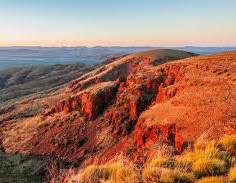
Picture is of Jack Hills, Western Australia.
Thanks goes to Google AI for its help in parts of this article.

